

When Sport Becomes Leadership: Indigenous Women Creating Spaces for Well-being and Transformation
2026 Indigenous Women’s Leadership Award
From football and hockey to the revitalization of ancestral games, Indigenous Women from different regions of the world are turning sport into a tool for well-being, self-care, autonomy, and the transformation of their communities. Today, we celebrate their contributions and their leadership.
Across different territories, Indigenous Women have redefined sport as something that goes far beyond physical activity or competition. They have created spaces to come together, strengthen their holistic well-being, exercise autonomy over their bodies, revitalize cultural practices, prevent violence, and open up new opportunities for girls and young women.
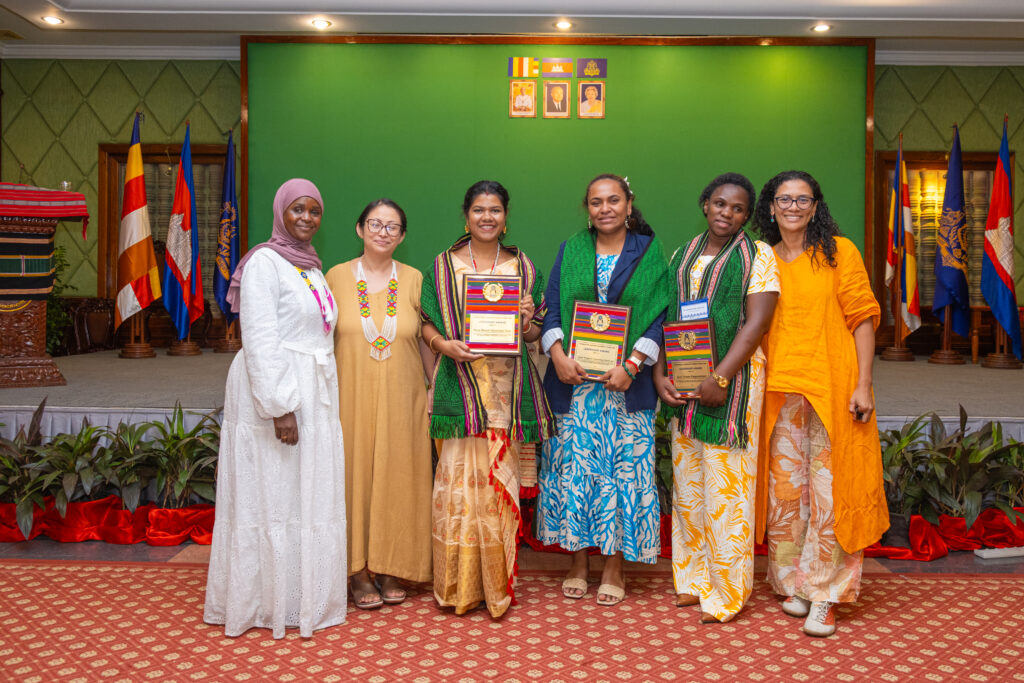
This transformative power inspired FIMI’s 2026 Leadership Award, dedicated this year to recognizing Indigenous Women’s organizations around the world that use sport as a tool for holistic well-being, self-care, autonomy, the defense of rights, and community transformation.
Winning Organizations of the 2026 Leadership Award
Africa | Awer Women Empowerment — Kenya
When the field can also become a place for healing
In Lamu, Kenya, a football field can be much more than the place where a match begins.
For Awer Indigenous Women and Girls who have experienced violence and conflict, coming together to play football or beach football can mean reconnecting with others, rebuilding trust, and restoring relationships that violence has put to the test.
Through its Play-Based Mental and Psychosocial Support program, the organization uses sport as a tool for psychosocial support. As they play, participants strengthen their self-esteem, develop empathy, rebuild social relationships, and find collective ways to cope with difficult experiences.
Running, forming a team, passing the ball, and knowing that someone will be there to receive it are simple actions, but they can also become experiences of trust and belonging. Sport creates a space where well-being is not built only individually: it is built together with others.
The Indigenous Women’s Leadership Award will enable Awer Women Empowerment to expand these activities, strengthen its support methodologies, and reach more women in the community.
Because after violence, recovering the possibility to play, trust, and feel part of a community can also be a way of building the future.
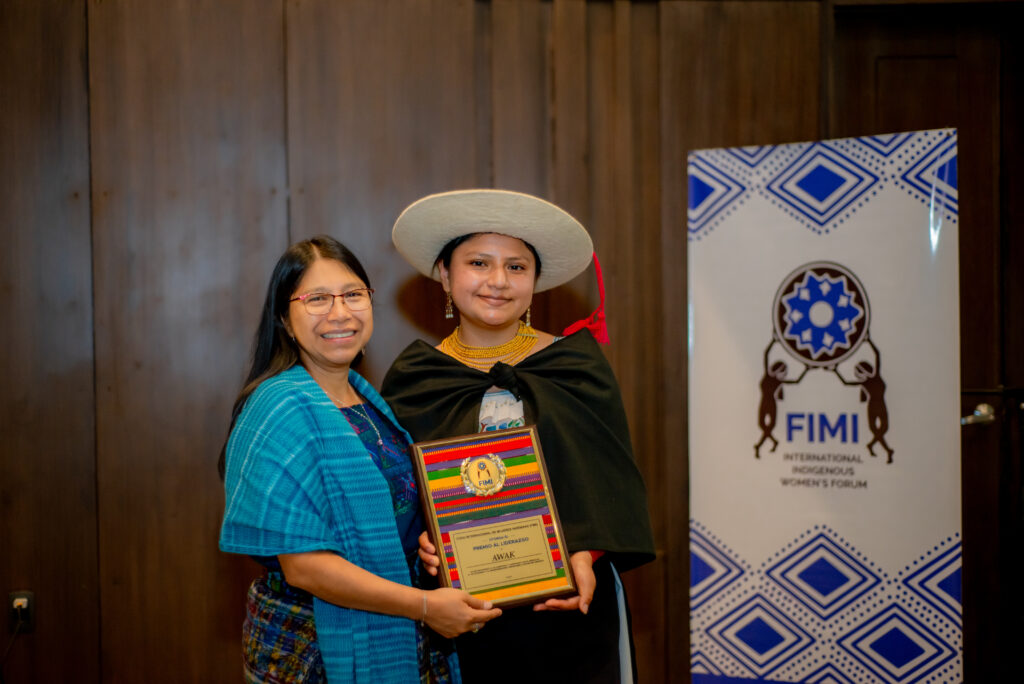
Latin America and the Caribbean | AWAK — Ecuador
Games that carry memory
Some forms of knowledge are not written in books. They live in the hands that teach weaving. In words spoken in Kichwa. In the memories of elders. And also in the games that one generation learns from another.
In the community of Camuendo, among the Kichwa Otavalo People, AWAK works to keep that memory alive and in motion. It also creates a space for intercommunity work between the communities of Loma Kunga and Camuendo Chico.
For the past eight years, the organization has revitalized traditional and ritual Kichwa games such as chunkana, curiquingue, kari atallpa shina, and encender la vela, connecting them with key contemporary issues for women and girls: self-care, community mental health, and the prevention of violence.
Its methodology has a name in its own language: Shimi rimahun maki rurahun.
Within it, play, weaving, memory, and ancestral knowledge come together. What might appear to be simply a recreational activity becomes a space where women strengthen their bonds, girls receive knowledge from previous generations, and cultural identity remains alive.
Now, the Indigenous Women’s Leadership Award will help take it further: facilitating the participation of women and girls living in remote areas and documenting ritual knowledge to help care for collective memory.
Because preserving a culture does not mean keeping it still. It means ensuring that its knowledge continues to pass from one pair of hands to another, that it can engage with the challenges of the present, and that new generations can find in it tools to build their own future.
Asia | Purva Bharati Educational Trust — India
A goal can change the place a girl imagines for herself
In Assam, India, stepping onto a football field can be the beginning of a story that continues long after the match ends.
For Adivasi girls and girls from tea garden worker communities, Girls for Goals, an initiative of Purva Bharati Educational Trust, uses football to create opportunities that can really make a difference in their lives: returning to school, staying in school, and strengthening their physical, mental, and emotional well-being.
The initiative has supported 100 girls. Changing a girl’s opportunities does not always mean working only with her. The expectations around her must also change. That is why Girls for Goals has engaged 200 mothers and fathers in conversations aimed at challenging the gender norms that shape girls’ participation in sport.
And something else has begun to happen. Some participants no longer see themselves only as players. Through training in advocacy, public speaking, and governance, they have begun to take on new roles as leaders within their communities.
The initiative’s growth can also be measured on the field. What began as a sports experience grew into a state-level tournament that brought together 58 teams in 2025–2026.
Now the challenge is to turn that momentum into something lasting. The Indigenous Women’s Leadership Award will contribute to strengthening the transition toward a permanent program that brings together sport, education, health, leadership, and community participation. Because perhaps one of sport’s most powerful outcomes is when a girl discovers that she can occupy a place she had never imagined for herself—and begins to wonder what other places she might occupy too.
Pacific | iTaukei Women in Conservation Youth Club — Fiji
From players to trailblazers
Then, the equipment. Transportation. An opportunity to train. A competition in which to participate.
For many iTaukei girls and young women in Fiji, practicing a sport also depends on whether the conditions exist for them to access it.
iTaukei Women in Conservation Youth Club works precisely on those conditions, expanding opportunities for girls and young women to play field hockey.
In collaboration with the Fiji Hockey Federation, the initiative works in schools and communities through sports clinics, competitions, and leadership training processes.
The results are beginning to show. Between 2024 and 2025, the number of girls’ teams participating in the National Secondary School Competition increased from 9 to 15.
Stepping onto the field is only part of the story. Young women are also finding pathways to remain in sport in other roles: as coaches, umpires, and leaders. In this way, it is not only the number of girls who play that is growing. The possibilities of who can teach, decide, lead, and become a role model for those who follow are also expanding.
The Indigenous Women’s Leadership Award will help strengthen access to equipment, transportation, sports facilities, training, and support to bring these opportunities to more communities in Fiji.
Opening a door matters. But truly transforming a space means ensuring that those who once walked through that door can keep it open for those who come next.
Sport as a Space for Leadership and Transformation
These experiences show that sport can become a space for healing, care, learning, revitalizing knowledge, building confidence, strengthening community, and exercising leadership.
A football field can be a place to rebuild connections. An ancestral game can keep collective memory alive. A tournament can open new educational opportunities for a girl. A hockey team can become a pathway to leadership.
The Leadership Award seeks to contribute to ensuring that these processes are recognized, strengthened, and shared, highlighting the diversity of spaces in which Indigenous Women are already leading and transforming their communities.